
奇美醫院以無線電子紙床頭卡,實踐高效率、低風險與永續並進的智慧醫院轉型
In the past, nursing stations handled numerous “non-clinical tasks,” such as printing, reviewing, and inserting paper cards to update bed information. With the full implementation of over 2,100 electronic paper bedside cards at Chi Mei Medical Center in early 2026, this decades-long tradition has become history. This represents more than a hardware upgrade; it marks a significant milestone for Taiwan’s smart healthcare journey toward “automation” and “green sustainability.”
A Truly Smart Hospital Must Begin in the Patient Rooms
For medical centers, digital transformation is never about “whether technology is implemented,” but rather “whether technology genuinely improves daily operations.” Chi Mei Hospital recognized this principle before fully implementing the e-paper bedside cards. While the project may appear as a simple display device in patient rooms, it actually impacts multiple dimensions: nursing workflows, information accuracy, patient safety, and hospital sustainability. Consequently, the e-paper bedside cards were positioned as a hospital-wide governance decision, not merely a departmental equipment upgrade.
Establishing the hospital-wide transformation direction with the president’s support
Chi Mei Hospital achieved full implementation across its Yongkang, Liuying, and Jiali campuses, covering 2,148 beds in just four months, from requirement confirmation to launch. The key to this smooth rollout was securing support from the management decision-making team. This was not merely a matter of meeting nurses’ needs but addressed whether the hospital’s overall operational model could become more efficient, safer, and more sustainable.
With support at the president level, the project adopted a hospital-wide perspective, integrating the Nursing Department, IT Office, and external technical teams to avoid fragmented implementation driven by siloed efforts. Before the e-paper bedside cards were introduced, paper bed cards were already part of daily ward routines, but the underlying burden they entailed was often underestimated. Patient transfers, medical order adjustments, and care note updates all necessitated reprinting, reviewing, or updating the cards. In the fast-paced ward environment, these tasks were not only time-consuming but also carried the risk of information not being updated in real time. Nursing Department Specialist Dong Yuzhen observed that the real pressure on nursing staff wasn’t the physical replacement of paper cards, but the constant need to ensure bedside information perfectly matched the system. Failure to do so could impact care decisions.
Project Design Core Principle: No Additional Burden on Frontline Staff
Based on this field insight, Chi Mei Medical Center established clear guidelines when planning its electronic paper bedside cards: avoid adding extra steps for nursing staff and prevent creating new management complexities. This principle was a key factor in selecting Pervasive Displays Inc., the wholly owned R&D center in Taiwan of Vusion group, the global market leader in electronic shelf label (ESL) solutions as the partner.
Pervasive Displays’ solution is not a standalone device but a fully integrated system combining e-paper displays (EPD), a backend management platform, and the hospital’s existing HIS (Hospital Information System). This makes the bedside card a natural extension of the system’s data. Through API integration, patient details and care notes are instantly synchronized to the bedside cards, eliminating manual updates. After implementation, nursing staff reported significantly streamlined workflows, no longer needing to divert attention from busy shifts to manage physical cards.
Display technology suited for hospital wards, not visual spectacle
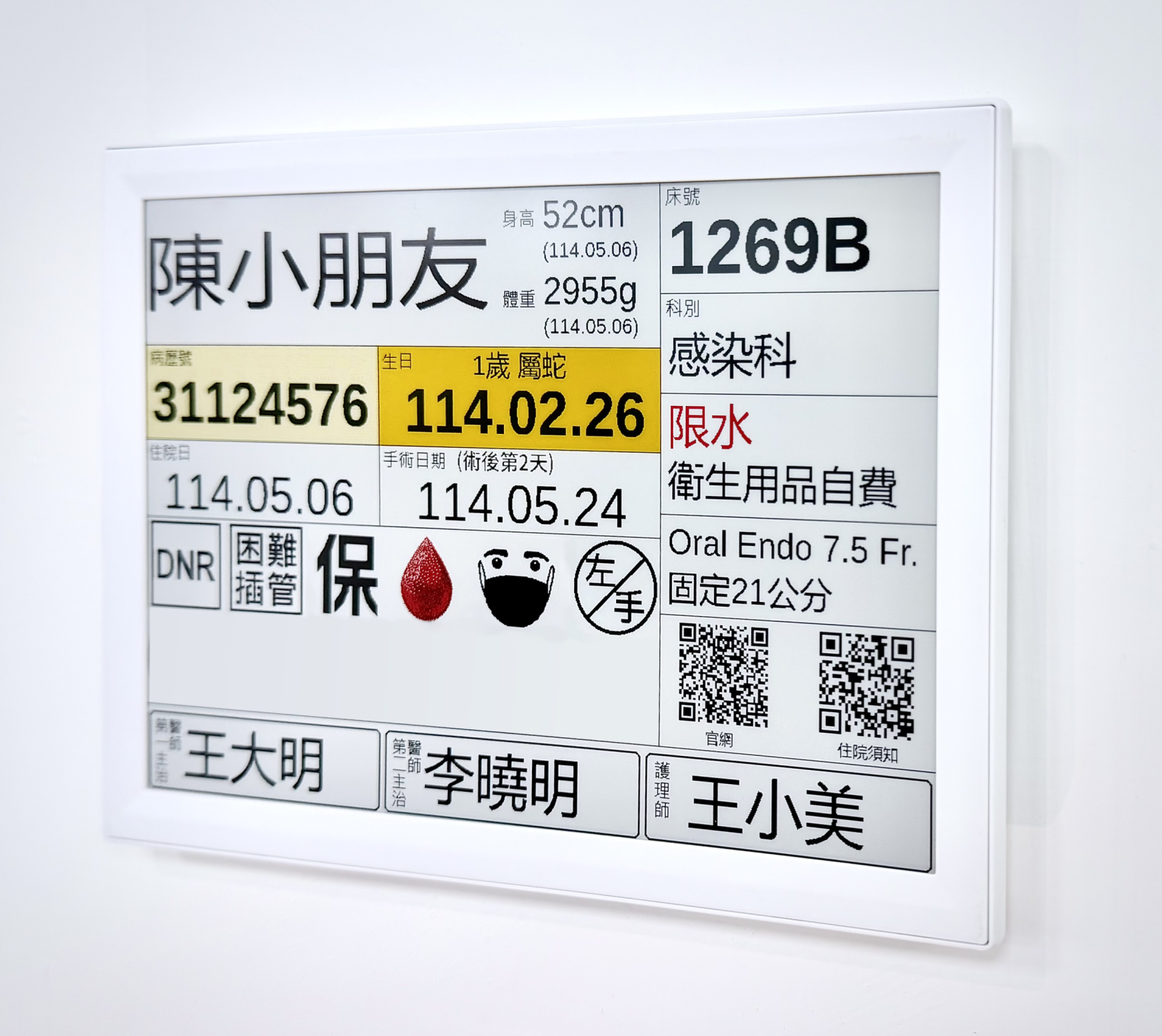
The e-paper bedside cards adopted by Chi Mei Medical Center eschew high-power full-color displays. Instead, they utilize e-paper with black, white, yellow, and red (Spectra 4, BWRY) colors of Pervasive Displays. Without backlighting, they are non-glare and do not disturb patient rest at night. The color scheme focuses on medical identification needs, enabling quick recognition of critical information such as fluid restrictions, treatment prohibitions, and fall prevention.
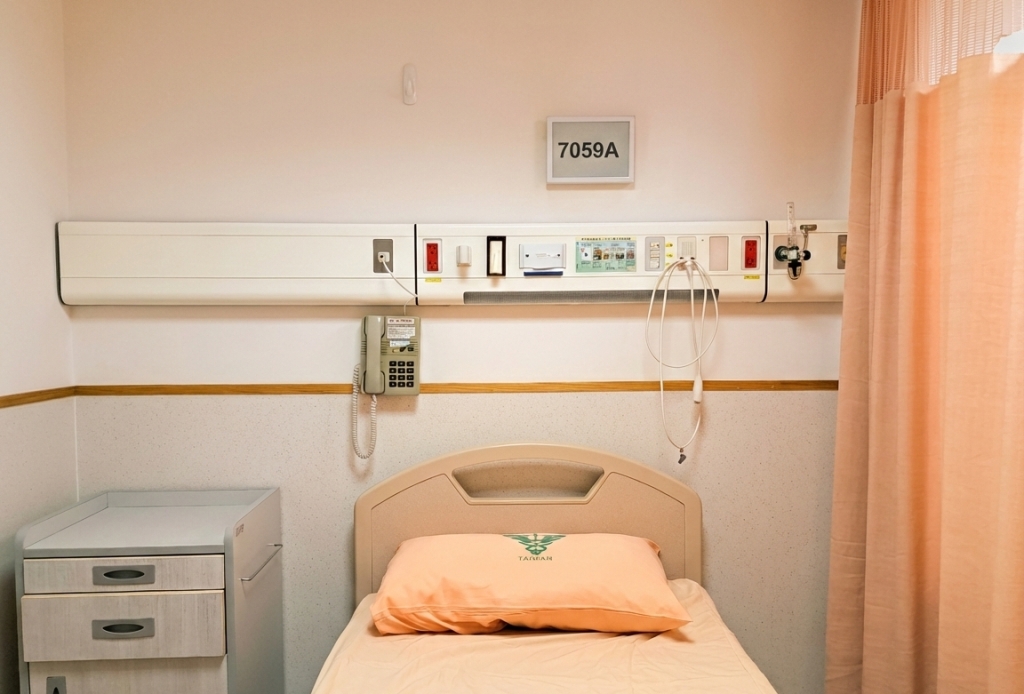
Another key project feature is its “truly wireless” design. Battery-powered and leveraging EPD’s bistable properties, the cards consume power only during screen updates, achieving over 5 to 10 years of battery life. No power or network cabling is required within patient rooms. This not only enhances installation flexibility but also reduces future maintenance and safety risks, representing a critical risk management design for the hospital’s long-term operations.
Leveraging existing Wi-Fi infrastructure substantially lowers implementation barriers
In terms of IT infrastructure, Pervasive Displays’ solution seamlessly integrates with the existing network of nearly 450 Cisco 9115AX Wi-Fi access points deployed across patient rooms in the three hospitals of the Chi Mei Medical System. No rewiring or additional dedicated equipment is required. Beyond supporting the original 2.4GHz ultra-low-power communication protocol, Pervasive Displays’ e-paper bedside cards are also compatible with Wi-Fi access points from major manufacturers. The IT department’s assessment indicates that this infrastructure integration design not only shortens the implementation timeline but also saves the hospital significant deployment and operational costs. This key technology is proprietary to the Vusion Group, with support extending to global networking giants such as Meraki, Aruba, Mist, Extreme, Juniper, and Fortinet.
Mr. Charming SU, Vice President and project lead at Pervasive Displays who assisted Chi Mei Medical Center in successfully implementing smart bedside cards, noted that Taiwan has nearly 500 hospitals with approximately 100,000 beds. Globally, over 160,000 hospitals and roughly 20 million beds now require transformation. The experience at Chi Mei Hospital demonstrates that with proper architecture and human-centered design, electronic tags can transition from retail to healthcare applications, becoming critical infrastructure for smart wards. Pervasive Displays will continue driving this “quiet revolution.” Leveraging Vusion group’s global technological foundation and collective strengths, we aim to strike a balance between high technology and compassionate healthcare, creating greater commercial and social value.
Paperless Operations and ESG Integration into Daily Workflows
With the full rollout of electronic paper bedside cards, paper bed cards have officially vanished from hospital wards. Going paperless is no longer merely a policy goal but a tangible change occurring beside every hospital bed. Combined with ultra-low-power display technology, hospitals reduce both consumables usage and energy consumption, laying the foundation for green wards and ESG sustainability metrics. Vice President and Chief Nursing Officer Chen Hsiu-Chin emphasized that sustainable design must integrate seamlessly into daily operations—not become an additional burden—for such transformation to hold long-term value.
A replicable model for other hospitals
Chi Mei Medical Center became Taiwan’s first hospital to simultaneously implement electronic paper bedside cards across all three campuses. Crucially, this achievement did not rely on special conditions but was built upon existing infrastructure, a clear governance framework, and a deep understanding of frontline needs. The value of a smart hospital ultimately returns to the patient care setting. Through this e-paper bedside card initiative, Chi Mei Hospital has transformed hospital-level governance from mere strategy into tangible outcomes: simplified nursing workflows, reduced information risks, and a more sustainable operational model.
Such a transformation is unassuming yet steadfast; quiet yet enduring.