
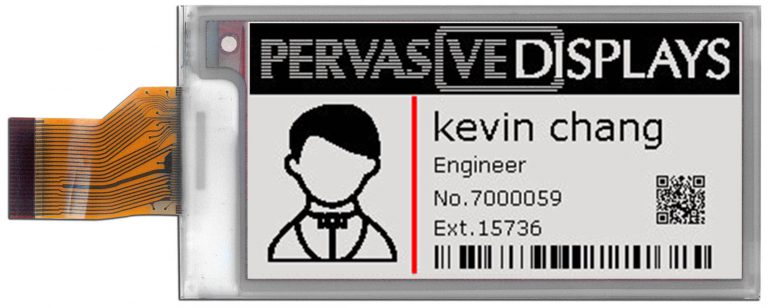
It’s a familiar ritual when you arrive at a conference: pick up your lanyard and name badge at the registration desk. This card displays a few static details for the duration of the event — your name, job title, employer, and event sponsors.
It’s an approach that has worked for decades, and while it’s effective, new technology means we can now take these name badges to another level.
Digital name tags
Rather than having a printed piece of card, imagine a digital name tag, capable of displaying richer, more varied or even context-sensitive information. Or one that was able to provide valuable insights for the event organisers.
At the heart of a digital name badge there will necessarily be some kind of display. The badge will also need to be battery-powered. And this combination has traditionally been a stumbling block for anyone trying to design a digital badge. Traditional thin-film transistor (TFT) liquid-crystal displays (LCDs), of the sort you have in your smartphone, use a lot of energy. They’re one of the reasons why modern phones need charging as frequently as they do. A conference name badge that cuts out part-way through the event or requires frequent battery changes or charges would be of little value. With potentially thousands of badges in use at a single event, you need a solution capable of operating for months or years without intervention.
However, swap the LCD for an e-paper display – like the ones in many e-book readers – and the story is very different. E-paper displays have no backlight, and don’t need to refresh constantly to maintain a static image. Once a delegate’s details are on the badge’s screen, keeping them there doesn’t require any energy at all.
Let’s explore how this could transform the humble conference badge – for both delegates and event organisers.
Modernising the conference name badge
At its very simplest, a digital badge with e-paper display could show static details. In this scenario, the badge itself wouldn’t even need a battery. Information could be loaded at the registration desk using near-field communication (NFC). The badge harvests radio frequency (RF) energy from the NFC terminal to update the display. Loading data onto this type of badge could be quicker than printing a paper one. And because the badges are reusable, they would reduce paper waste.
A more sophisticated option would be to include a small battery, such as a CR2032 coin cell. This would enable conference organisers to load the badge with a sequence of information to display throughout the day. Alongside the individual’s name and employer, it could show directions to the next session or a sponsor’s logo. Updates to the screen require very little energy, so such a battery could last months or even years between changes.
Taking it further
Why not include some form of low-power wireless communication technology? This would enable event organisers to send information to delegates’ badges while they’re on the conference floor. Add a location sensor, and information could be tailored to the individual’s whereabouts.
The location-awareness would have other uses too, enabling the organisers to track and understand the way people move around the event. These insights could help them plan the layout of future conferences more effectively.
Readily available technology
The characteristics of e-paper make it ideal for use in next-generation conference delegate badges. The technology is mature and easily available, with both development kits and large volumes of displays simple to source.
Blogger: Scott Soong, CEO, Pervasive Displays