
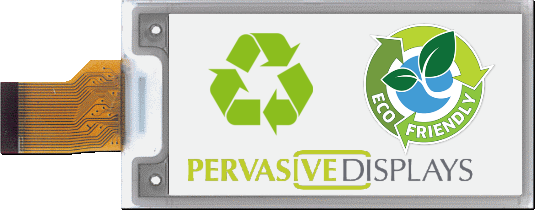
As a comprehensive solution, electronic paper, also known as e paper display, offers an extensive array of practical applications that are yet to be fully explored. Users across various industries are astounded by the tremendous benefits this innovative technology brings. It enables them to achieve cost reduction, enhance overall production efficiency, and provide an optimal consumer experience. This article provides a comprehensive understanding of the fundamental principles of electronic paper, its advantages and diverse applications, and helps you locate the precise product that meets your requirements.
Introduction to Electronic Paper technology: An amazing e paper display?
What is an Electronic Paper Display?
Electronic paper can be referred to as e paper, e-paper or ePaper. These names are sometimes confused with others such as electronic ink, e ink, or e ink display. Depending on the manufacturer and corporate strategy, all these terms point to the same concept: the ingenious mimicry of traditional ink on paper. Technological innovation has made jotting down words on paper a thing of the past! Images and information can now be clearly retained on electronic paper, with the same degree of crispness, sharpness and readability, if not higher.
How does e paper display technology work?
The core of e paper display technology lies in how images are displayed and why e-paper outperforms high-resolution screens. Imagine each e-paper display as a pool filled with millions of microscopic capsules, roughly the thickness of a human hair. These capsules contain tiny ink particles of various colors swimming in a clear fluid, all encapsulated within a thin film.
In this basic form of an e paper display, the eink display capsules consist of black and white particles. Black pigments, negatively charged and reflective, contrast with positively charged non-reflective white pigments. Electrodes positioned above and below the capsule film apply an electric field. This causes particles with the corresponding charge to float or sink, resulting in specific colors on the eink display surface.
In essence, these electrically charged particles operate on the principle of electrophoretic display (EPD). The motion of these scattered molecules, rearranged within fluid-filled capsules under the influence of an electric field, paints the surface of a new world, illuminating the advancements in display technology.
Now that we understand the basics, let us analyze the advantages of the e paper display. We will also compare Electronic Paper with LCD to explain why this technology is rapidly gaining adoption.
Register now to request a free e-paper development kit with an EPD (E-Paper Display). Kick-start your low-power display device for interactive, ultra-fast refresh, and wider operating temperature range applications.
Advantages of Using Electronic Paper: Compare E Paper Display (EPD) with LCD
What are the advantages of Using Electronic Paper?
E paper Display can display without a power source
An EPD helps resolve the business difficulties experienced by digital signage integrators and commercial companies. Display failures during power shortages or lost internet connectivity are no longer a concern. The last uploaded information always remains on display, even when the screen fails to refresh. There are no blue screens or error messages — a significant improvement over conventional display technologies.
Electronic Paper is Ultra-low Power Displays
Electronic paper technology consumes power only when the information on screen is being refreshed. It requires no continuous energy while displaying static content. This makes it advantageous for energy efficiency and long-term use. It is particularly suitable for applications such as e-book readers, price tags, and public information displays.
E-paper Display High Contrast and Reading Comfort
Greater contrast and reflectivity also give ePaper higher-quality readability. Being a reflective technology means being sunlight readable, and unlike the embedded LCD technologies, ePaper needs no power to light up the screen. Therefore, the ePaper rule of thumb goes like this: If one could read a piece of paper, one can read an ePaper.
Compare between E Paper Display (EPD) and LCD
Unlike liquid crystal displays, which require refreshing about 30 times per second, EPD technology achieves ultra-low power DC field addressing. This is due to its bi-stable nature. In practice, an electronic ink display consumes power only when the information on screen is being modified. Just like ordinary ink on paper, an EPD holds an uploaded text or static image in perpetuity without a power source, delivering amazing battery longevity.
Here is the comparison table of e-paper display and LCD, the reference link is inserted here:
| E-paper Display | LCD | |
|---|---|---|
| Thickness | E-paper display is about 1 millimeter in thickness | LCD is relatively thicker (approximately 7 millimeters) |
| Readability in Sunlight | Readable in sunlight | Hard to read in sunlight (needs strong backlight) |
| Portability | It is easier to carry E-paper due to its light weight | It is relatively difficult to carry LCD due to its heaviness which is because of the glass screen and power systems. |
| Power Requirements | Only consumes power when the image is changed | Consume power while holding images. |
| View | A viewing angle of 180 degrees, i.e. it can be viewed from anywhere if you are in front of it. | LCD can be best viewed only from the center front of the screen. |
| Pixel Visibility | E-paper display uses reflection of light for pixels to be visible | LCD uses back light illumination for pixel visibility. |
E-paper Display Application in Various Industries
The demand for digitalization drives improvements in work efficiency and accuracy. However, certain sectors still rely on manually updating whiteboards and data cards for internal communication. This leads to increased risks of errors and information omissions, longer working hours, and heavier workloads. Electronic paper displays offer advanced solutions that enable establishments to make better decisions with clear visibility. They reduce reliance on outdated manual methods and enhance overall effectiveness.
E paper Display Application 1: Healthcare Industry
Patient door signs:E-paper door signs can now connect wirelessly to healthcare facilities and hospitals, updating and forwarding patient information in real-time.
Patient care signs:By wirelessly connecting to HIS/EHR/EMR systems, e-paper care signs automatically display medical alerts and patient records such as allergy precautions. Integrated and swift doctor-patient communication builds mutual trust and improves healthcare conditions. It also enhances medical staff efficiency.
Communication boards: E-paper communication boards installed inside patient rooms display medical schedules and treatments in real-time. They also serve as a communication portal between the patient, the medical team, and family and friends.
E paper Display Application 2: Retail
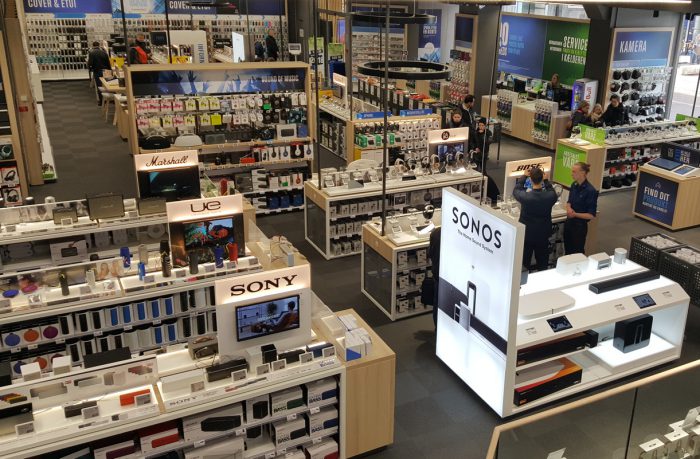
Electronic Shelf Labels: E-paper Shelf Labels (ESLs) allow retailers to wirelessly and instantly update label content on shelves. This eliminates the need to print paper labels or deploy manual labor for replacements. Retailers can achieve dynamic promotional pricing, price agility, out-of-stock reminders, template switching, special event messages, and QR code scanning. Headquarters can remotely control individual labels in any corner of the world.
Pervasive Displays have also announced a TFT active matrix module that provides a freezer-friendly, easily-readable electronic paper display (EPD) of information down to teeth-gritting temperatures of -25° C (-13 °F). This module operates at ultra-low temperatures with remarkably low power consumption. It is ideal for labeling, tagging, and informational applications in cold environments such as cold-chain logistics, food packaging, and frozen food storage. Its high resolution and high integrability help designers speed up product development.
E-paper displays have a remarkable effect on menu boards in restaurants, food stores, and dining establishments. They outperform conventional LCD displays with a natural look that eliminates unwanted glare and reflections. Smooth images and sharp text make food look more delicious and appealing.
E paper Display Application 3: IoT
Digital information boards: Electronic paper provides high-contrast display, centrally updates real-time information and service alerts, and has excellent direct sunlight readability. Connecting sensors and environmental monitoring meters, E-paper display can show key dynamic information and remind managers with its ultra-low energy consumption characteristics. Electronic paper can be used as an excellent display device for the Internet of Things applications.
Notebooks: E-paper is reflective, non-self-illuminating, and eyeball-friendly. Applicable to productivity tools such as computers, and suitable for reading over a long period. Interactive use with LCDs for greater work efficiency.
Taking e-paper notes: The E-paper notepad with handwriting functions gives access to note-taking by hand while reading or during lessons. It contributes to lower consumption of paper and dramatically reduces the weight of schoolbags and the stress on student eyesight when used as teaching or academic research materials at school.
E paper Display Application 4: Industrial 4.0 / Warehousing

Logistics labels: During transportation, logistics labels display the product name, destination, current status, and other package information. They support real-time tracking via RTLS (real-time locating system). The electronic paper with ultra-low power consumption and permanent display is an exemplary demonstration of application in the industrial field.
Smart packaging: E-paper displays offer the advantages of flexibility, low energy consumption, and long-lasting images. Even in the case of complete power exhaustion, basic information will still remain on the packaging, proving feasibility for futuristic smart packaging.
Warehouse management labels: The e-paper warehouse label system plus LED flashing prompts makes package identification and positioning more convenient. It also gives warehouse personnel greater latitude for pick-ups and speed. With temperature and humidity sensors, products can be monitored in special storage environments. Connecting the warehouse label wirelessly to the management system enables real-time inventory updates and improves management efficiency.
Introducing Pervasive Display: A choice for E paper Display Products
Who is Pervasive Display?
Pervasive Displays is the leader in e paper displays for IoT applications. The company designs, manufactures, and markets e paper displays delivering high resolution, ultra-thin form factor, sunlight readability, and ultra-low power consumption. Pervasive Displays provides suitable solutions for businesses which hope to gain use of Electronic Paper Display technology.
Popular Electronic Paper Display Products of Pervasive Display: EPD development kit
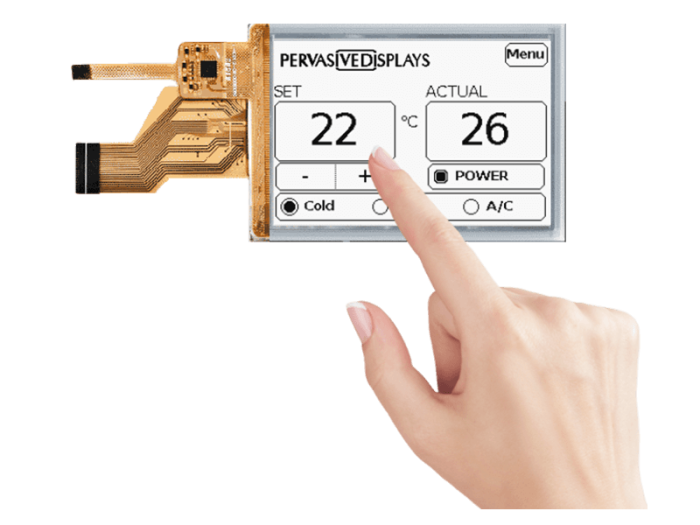
The 2.71” or 3.7” Projected Capacitive Touch panel is laminated on a monochrome e-paper display (EPD). It features an internal Timing Controller and partial update driving waveform for high-resolution image quality and fast refresh. The sub 5″ EPDs also enable diverse applications across a wide range of use cases.
Pervasive Displays further facilitates the use of e-paper technology through the 2.71”-Touch EPD, 3.70”-Touch EPD, the EPDK-Touch kit, the Pervasive Displays Library Suite (PDLS), and full documentation.
The new EPD touch panels and EPDK-Touch kit provide a simpler way of evaluating the many features and benefits of EPD technology for human machine interface (HMI) applications. Embedded fast and partial updates ensure responsive interactions. Engineers can evaluate HMI with e ink e-paper displays and develop applications faster. Users benefit from a more enjoyable visual interaction experience.
The EPDK-Touch helps engineers to discover and assess e-paper technology, compare it to other display technologies, test different host micro-controllers and memory configurations, evaluate different screen sizes, before making final decisions.
Pervasive launches a new large range of wide temperature eink displays from the existing dimensions for small and medium sizes in 2023, including < 6”,1.54”, 2.13”, 2.66”, 2.71”, 3.7”, 4.2”, 4.37” and 5.8”. Developers and their products can upgrade directly without any mechanical changes. This enables deployed products to operate in a wider temperature range. Pervasive will launch new size range of wide temperature eink displays for large sizes in the second quarter of 2023, including > 5”, 7.4”, 9.7” and 12”.
Sizes and Colors of Pervasive Display Electronic Paper
With more colors in the family, we continue to provide improved multi-color platforms with various options of display sizes on which incredible and versatile projects can be and realized. Users can now drive the EPD with embedded OTP LUT (One-Time Programmable LookUp Table). Available sizes include small formats from 1.54” to 4.2”, mid-sizes from 5” to 7”, and large formats from 9.7” to 12⅖, serving a wide range of industries and applications. The e paper display (EPD) T-con embedded single driver, with the major SPI control interface, has such high resolution that it is able to display fine patterns with relative ease. The host sends both the setting commands and the display images to the driver through the SPI bus.
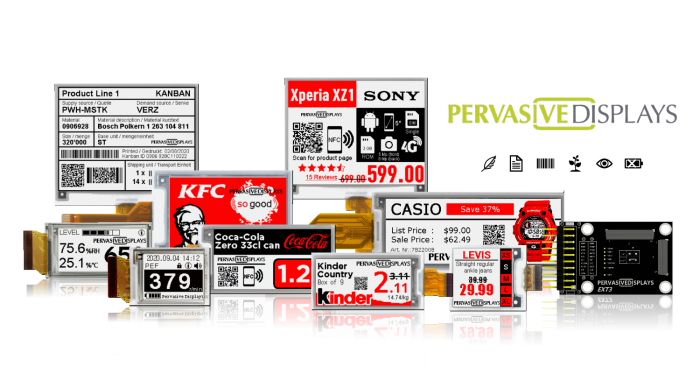
Due to its bi-stable nature, the EPD panel requires very little power to update and needs no power to maintain an image. And images now come in a line of compact black, white, and red colors, giving product and service designers greater flexibility with a combination of colors.
Currently Pervasive supports an entire range of iTC ultra-low power e-paper displays, monochrome and tri-color (black-white-red), from the 1.54” Aurora to the 12” Spectra. This opens a whole new dimension for EPDs — they can now act as input devices for human machine interface (HMI). This is a perfect configuration for ultra-low power IoT remote controls. The kit features help engineers discover and assess E ink e-paper technology, compare display technologies, test host micro-controllers and memory configurations, and evaluate different screen sizes and colors before making final decisions.
Development Kits with 2.71” or 3.70” touch panels are available at Mouser and Digikey from June 2022. The EPDK-Touch bundle combining an EXT3-1, EXT3-Touch, 3.7” touch panel and Raspberry Pi Pico will also be available at Amazon and SparkFun this July.
Pervasive is set to launch a four-color electronic paper product in the second quarter of 2023, featuring black, white, yellow, and red.
Electronic Paper technology can not only display without a power source, but also provides High Contrast and Reading Comfort. This technology is not a future thing. Healthcare Industry, retail, IoT and so many other fields are making use of E paper Display. To understand more about Pervasive Display, click the link below.
Introducing Pervasive E-paper Display Products
Popular Electronic Paper Display Products
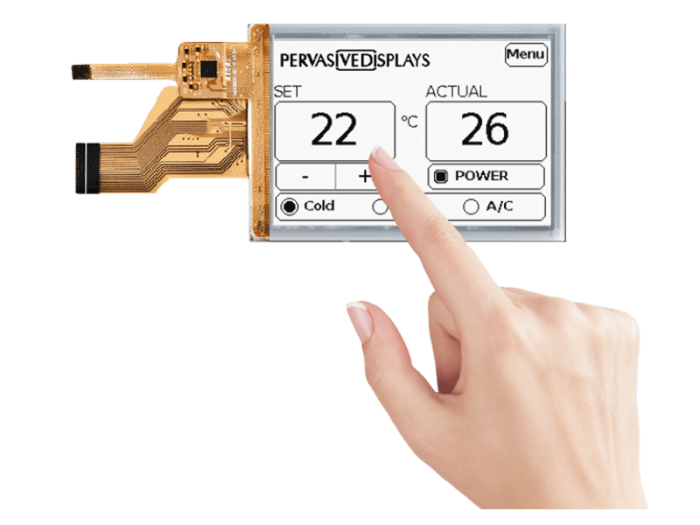
The 2.71” or 3.7” Projected Capacitive Touch panel is laminated on a monochrome e-paper display (EPD) with internal Timing Controller and partial update driving waveform embedded to provide the high resolution image quality and fast refresh . The sub 5” EPDs also provide a wide range of various use cases above to enable diverse applications.
Pervasive Displays further facilitates the use of e-paper technology through the 2.71”-Touch EPD, 3.70”-Touch EPD, the EPDK-Touch kit, the Pervasive Displays Library Suite (PDLS), and full documentation.
The new EPD touch panels and EPDK-Touch kit provide a simpler way of evaluating the many features and benefits of EPD technology for human machine interface (HMI) applications. Embedded fast and partial updates ensure responsive interactions. Engineers can evaluate HMI with e ink e-paper display and develop applications easier and faster for users to experience the visual enjoyment of interaction.
The EPDK-Touch helps engineers to discover and assess e-paper technology, compare it to other display technologies, test different host micro-controllers and memory configurations, evaluate different screen sizes, before making final decisions.
Pervasive launchs a new large range of wide temperature eink displays from the existing dimensions for small and medium sizes in 2023, including < 6”,1.54”, 2.13”, 2.66”, 2.71”, 3.7”, 4.2”, 4.37” and 5.8”. Developers and their products can upgrade directly without any mechanical changes. This enables deployed products to operate in a wider temperature range. Pervasive will launch new size range of wide temperature eink displays for large sizes in the second quarter of 2023, including > 5”, 7.4”, 9.7” and 12”.
Sizes and Colors
With more colors in the family, we continue to provide improved multi-color platforms with various options of display sizes on which incredible and versatile projects can be and realized. Users can now drive the EPD with embedded OTP LUT(One-Time Programmable LookUp Table). now including “small” sizes ranging from 1.54“, 2.13“, 2.66“, 2.7“, and 2.87“ all the way to 4.2“, mid-sizes 5” to 7“, and large 9.7” to 12″ available for the extensive use of different industries and purposes. The e paper display (EPD) T-con embedded single driver, with the major SPI control interface, has such high resolution that it is able to display fine patterns with relative ease. The host sends both the setting commands and the display images to the driver through the SPI bus.
Due to its bi-stable nature, the EPD panel requires very little power to update and needs no power to maintain an image. And images now come in a line of compact black, white, and red colors, giving product and service designers greater flexibility with a combination of colors.
Currently Pervasive supports an entire range of iTC ultra-low power e-paper displays, monochrome and tri-color (black-white-red), from the 1.54″ Aurora to the 12″ Spectra. This opens a whole new dimension for EPDs — they can now act as input devices for human machine interface (HMI). This is a perfect configuration for ultra-low power IoT remote controls. The kit features help engineers discover and assess E ink e-paper technology, compare display technologies, test host micro-controllers and memory configurations, and evaluate different screen sizes and colors before making final decisions.
Development Kits with 2.71” or 3.70” touch panels are available at Mouser and Digikey from June 2022. The EPDK-Touch bundle combining an EXT3-1, EXT3-Touch, 3.7” touch panel and Raspberry Pi Pico will also be available at Amazon and SparkFun this July.
Pervasive is set to launch a four-color electronic paper product in the second quarter of 2023, featuring black, white, yellow, and red.